
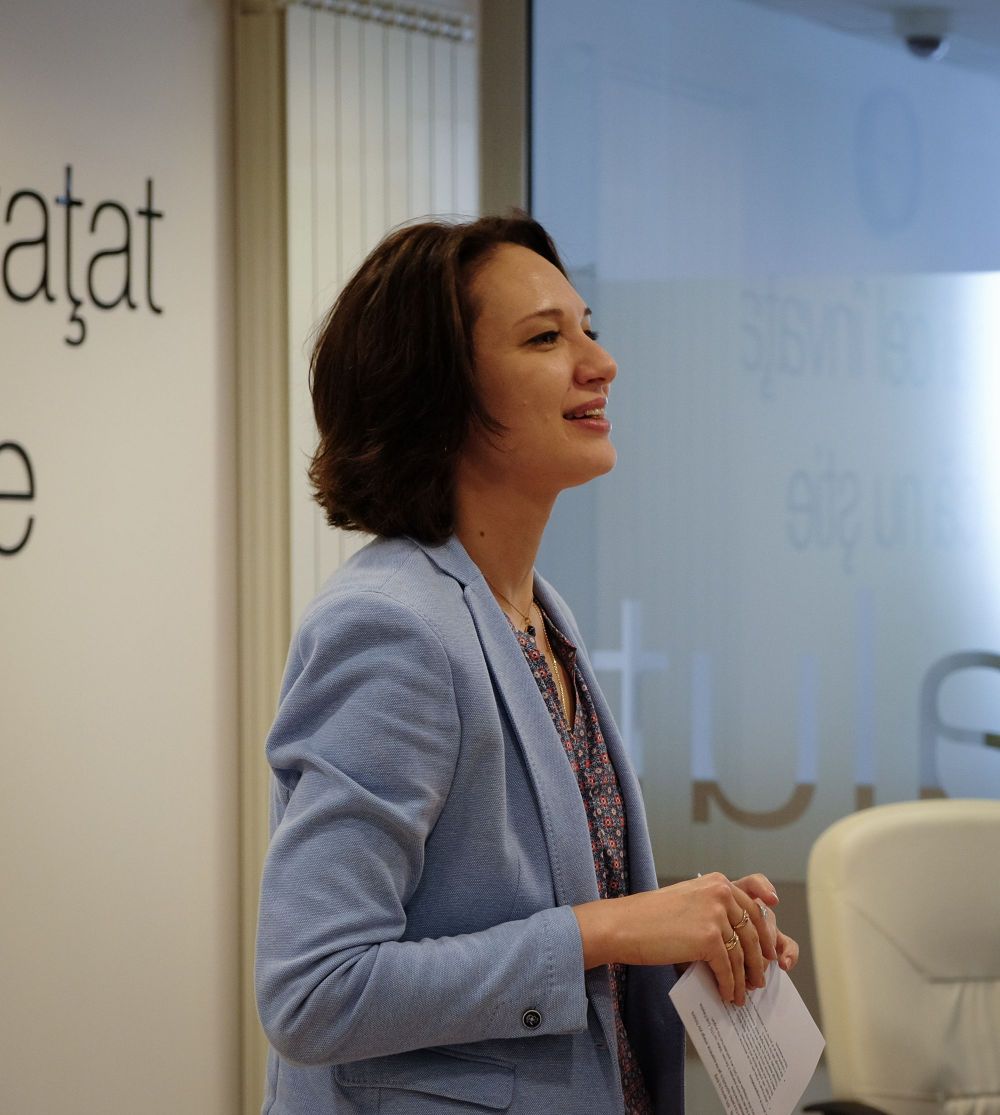
The invitation to participate as a guest lecturer on behalf of Ericsson Romania in the Orange Educational Program, dedicated to master’s students, was both a very pleasant surprise and an extremely rewarding experience. The moments when I witnessed the amazed expressions on the faces of future telecom graduates as they learned about current and future benefits and applications of IT and telecommunications solutions across various industries — some of which may be difficult to imagine — were, for me, a powerful confirmation that we are part of an industry in constant transformation, one that continues to play a key role in society. Thank you, Orange Romania, for the opportunity. I hope we will continue to collaborate on such initiatives.
— Răzvan Pârvu, Ericsson (2014)
— Răzvan Pârvu, Ericsson (2014)
The micro-course introducing Telecom Economics, a much shorter version of the course “The Telecommunications Market. European and International Regulations” that I teach to ETTI students, aims to present the other side of telecommunications—the business side. Offering such a course is a challenge considering the audience: final-year students with outstanding results, the elite selected for the Orange Educational Program—a one-year training program, primarily technical, designed to familiarize them with the technology used by a mobile operator and prepare them to integrate into such an organization. The program aims to address and focus on aspects not yet covered in the academic curriculum. It is also intended to help shift students’ mindsets to adapt to a specific organizational culture.
Why such a course? Because telecommunications is also a business, operating in a market where technologies, services, and products are tested daily, and only those that become profitable ventures survive. This helps students understand why some technologies disappear in favor of others (e.g., CDMA losing out to GSM/UMTS/LTE), why certain services are replaced (e.g., fixed telephony by mobile), why the lifecycle of products, services, or technologies has accelerated in recent years, and what all of these have in common—revenue, costs, profit: in other words, the business. And all of this happens in the marketplace, the space—sometimes virtual—where demand meets the supply of products, services, and technologies.
The landscape is shaped by the market’s main players: buyers—the users of services, products, and technologies—who ultimately decide the outcome by choosing one product over another; telecom operators who compete by offering services, products, and technologies; equipment manufacturers, without whom technical progress would not be possible; and regulators, the referees of this competition. And, of course, the macroeconomic context—both national and international—in which this industry operates and which influences the decisions of all participants.
Why should a future telecom engineer know all this? To understand how an organization they might work for is structured. Because those working in mixed sales teams will also need to conduct economic evaluations. Because some of them, sooner or later, will occupy leadership positions where decisions must often be grounded in economics. Students can understand, through examples from our local market, that the recipe for success in reaching a leadership role often involves complementing their economic knowledge with a Master of Business Administration program, which can give them a business understanding of telecommunications.
Thus, the micro-course aims to serve as a guide for the future careers of tomorrow’s telecom engineers. Given the highly technical audience, the micro-course had to be far more interactive than the master’s-level course I usually teach, inviting students to debate scenarios, express their opinions on case studies, and explain what happened or what could happen. The discussions and debates held during the mere 8 hours of the course may be a sign of their interest in the economic side of telecommunications—in the business itself.
The micro-course also serves as a preview or preparation for the course “The Telecommunications Market. European and International Regulations,” which these students can take in the second year of their master’s studies. The course benefited from the excellent conditions provided by the Orange Educational Program, including a well-equipped classroom that fostered discussion and perhaps offered a glimpse of the environment these students may one day encounter as future Orange employees.
— Nicolae Oacă, PhD, MBA (2013)
Why such a course? Because telecommunications is also a business, operating in a market where technologies, services, and products are tested daily, and only those that become profitable ventures survive. This helps students understand why some technologies disappear in favor of others (e.g., CDMA losing out to GSM/UMTS/LTE), why certain services are replaced (e.g., fixed telephony by mobile), why the lifecycle of products, services, or technologies has accelerated in recent years, and what all of these have in common—revenue, costs, profit: in other words, the business. And all of this happens in the marketplace, the space—sometimes virtual—where demand meets the supply of products, services, and technologies.
The landscape is shaped by the market’s main players: buyers—the users of services, products, and technologies—who ultimately decide the outcome by choosing one product over another; telecom operators who compete by offering services, products, and technologies; equipment manufacturers, without whom technical progress would not be possible; and regulators, the referees of this competition. And, of course, the macroeconomic context—both national and international—in which this industry operates and which influences the decisions of all participants.
Why should a future telecom engineer know all this? To understand how an organization they might work for is structured. Because those working in mixed sales teams will also need to conduct economic evaluations. Because some of them, sooner or later, will occupy leadership positions where decisions must often be grounded in economics. Students can understand, through examples from our local market, that the recipe for success in reaching a leadership role often involves complementing their economic knowledge with a Master of Business Administration program, which can give them a business understanding of telecommunications.
Thus, the micro-course aims to serve as a guide for the future careers of tomorrow’s telecom engineers. Given the highly technical audience, the micro-course had to be far more interactive than the master’s-level course I usually teach, inviting students to debate scenarios, express their opinions on case studies, and explain what happened or what could happen. The discussions and debates held during the mere 8 hours of the course may be a sign of their interest in the economic side of telecommunications—in the business itself.
The micro-course also serves as a preview or preparation for the course “The Telecommunications Market. European and International Regulations,” which these students can take in the second year of their master’s studies. The course benefited from the excellent conditions provided by the Orange Educational Program, including a well-equipped classroom that fostered discussion and perhaps offered a glimpse of the environment these students may one day encounter as future Orange employees.
— Nicolae Oacă, PhD, MBA (2013)
Participation in the Orange Educational Program was a great opportunity for Cisco to combine its technical training activities, through the Cisco Academies, with a strong practical component focused on the needs of mobile operators. The rapid evolution of connectivity demands—from both people and “things”—is an opportunity that Cisco addresses in its collaboration with the world’s leading mobile operators, of which Orange is a key part, as part of the "Internet of Everything" strategy..
— Ovidiu Nechină, CISCO
— Ovidiu Nechină, CISCO
Being passionate about telecommunications, I began my professional career with five years in the commercial department at Motorola. I then spent the next ten years as part of the startup and later sales team at Orange, before returning to the technology vendor industry—this time at ZTE Corporation.
Believing that behind every employee’s growth lies countless hours of professional training, I gladly accepted when a dynamic and highly experienced team from Orange Romania invited us to help train young students from the Faculty of Telecommunications in Bucharest. Over several months, engineers and managers from both Orange and ZTE delivered a well-deserved and interactive lesson in telecom network operations—both in lab environments and real-world scenarios—covering topics such as NG-HLR, LTE operating principles, VAS, and MMSC.
Attending the opening session of the courses offered in partnership with Orange Romania, I was pleasantly surprised by the large number of students, as well as the thoughtful and focused questions they raised—questions that made their way onto the agenda of both the operator and the technology provider.
On behalf of ZTE Corporation, I would like to thank all the graduates of the interactive courses organized by Orange Romania and ZTE for their commitment, for the enthusiasm that defines this new wave of specialists, and for the high level of knowledge with which they will soon enter the major operations, service, or management centers. I would also like to thank my former colleagues at Orange Romania, the operator’s leadership, and the experts from ZTE Romania for this cognitive-pedagogical initiative and for the flawless organization of the training sessions dedicated to the new professionals of the telecom industry.
— Lorian Vintilă, Chief Marketing Officer – ZTE CEE
Believing that behind every employee’s growth lies countless hours of professional training, I gladly accepted when a dynamic and highly experienced team from Orange Romania invited us to help train young students from the Faculty of Telecommunications in Bucharest. Over several months, engineers and managers from both Orange and ZTE delivered a well-deserved and interactive lesson in telecom network operations—both in lab environments and real-world scenarios—covering topics such as NG-HLR, LTE operating principles, VAS, and MMSC.
Attending the opening session of the courses offered in partnership with Orange Romania, I was pleasantly surprised by the large number of students, as well as the thoughtful and focused questions they raised—questions that made their way onto the agenda of both the operator and the technology provider.
On behalf of ZTE Corporation, I would like to thank all the graduates of the interactive courses organized by Orange Romania and ZTE for their commitment, for the enthusiasm that defines this new wave of specialists, and for the high level of knowledge with which they will soon enter the major operations, service, or management centers. I would also like to thank my former colleagues at Orange Romania, the operator’s leadership, and the experts from ZTE Romania for this cognitive-pedagogical initiative and for the flawless organization of the training sessions dedicated to the new professionals of the telecom industry.
— Lorian Vintilă, Chief Marketing Officer – ZTE CEE
As a representative of Nexans, I fully support Orange's initiative to organize the educational program for training future telecom specialists, the "Orange Educational Program." We were truly pleased to have the opportunity to share with OEP scholarship students a small part of the experience we’ve accumulated over the years. What impressed us most was the students’ high level of engagement throughout the entire course. Another aspect worth mentioning is the flawless organization, which can only lead to excellent results. I would highly recommend more students to become an active part of this project, as they have everything to gain from it. .
— Bogdan Hebean, Business Development Manager Eastern Europe – Nexans Group
— Bogdan Hebean, Business Development Manager Eastern Europe – Nexans Group